
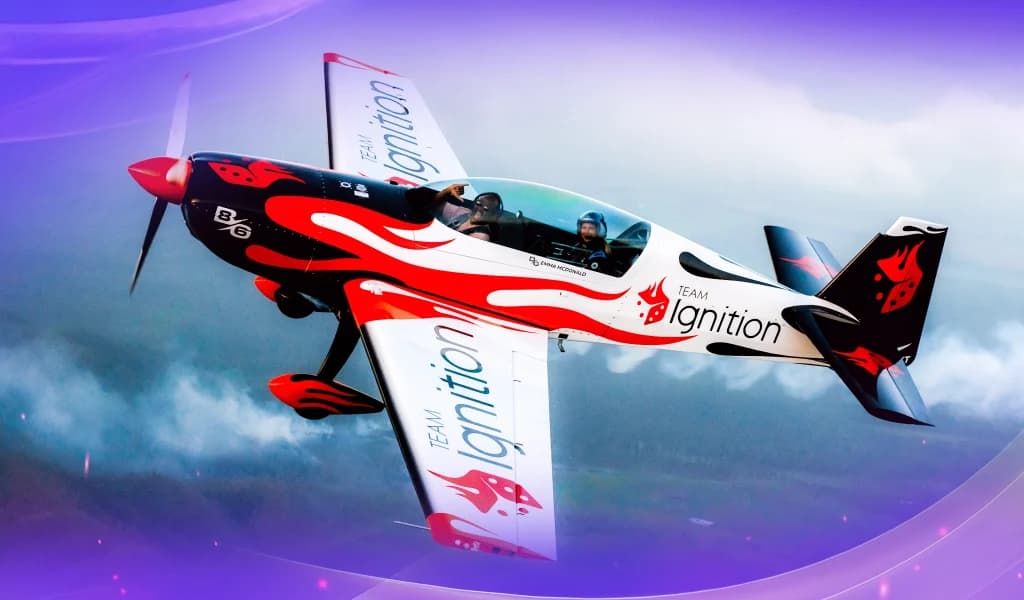
When Selema Masekela stepped into the passenger seat of Emma McDonald’s aircraft, there was no easing in. Within moments, the ground fell away and the flight turned visceral—barrel rolls, snap turns, and an 8G maneuver that pushed the limits of the human body:
What is Aerobatic Flying?
On a normal airplane flight, even a little dip can be terrifying. For aerobatic flyers, a day without flipping a plane over completely is a dull one. Essentially, aerobatic pilots use precise, controlled maneuvers to make a plane “dance in the air.” Their tricks include loops, rolls, spins, inverted flight, and lots more. They push their aircraft (and themselves) to the very edge of what they can control.
If you’ve ever been to an airshow, you’ve probably been treated to some aerobatic flying. It looks amazing from the ground and can sometimes even be scary to watch, but aerobatic pilots have an advanced ability to control an aircraft through challenging maneuvers. Aerobatics is now a well-established competitive sport worldwide. But where did it start?
How Did Aerobatic Flying Begin?
The first famous flight of the Wright brothers at Kitty Hawk, North Carolina, took place in 1903. By the time of the first World War in 1914, airplanes had already become a key part of military combat. As a result, following the war, there were many skilled pilots who had been tested under the most high-pressure circumstances. Dizzying maneuvers for them meant the difference between life and death. Loops, rolls, and climbing were all necessary tactical moves a pilot had to have in their toolbox to get through a dogfight or bombing run. When these pilots returned home, some of them began to show off their elite skills in air exhibitions.
The era of aerobatic flying had begun.
As the years advanced, aeronautic engineering did too, delivering stronger planes that were easier to control with great precision. Organized aerobatic competitions sprang up, and along with them, the first champion trick pilots. Governing bodies like the Fédération Aéronautique Internationale (FAI) were formed so that pilots could agree on standardized figures, along with a scoring system and safety rules. In this way, aerobatics is much like figure skating or a modern extreme sport like street skateboarding. Experimental moves became a structured discipline with formal training paths, and international championships gave pilots worldwide bragging rights.
Aerobatic Flying Tricks List
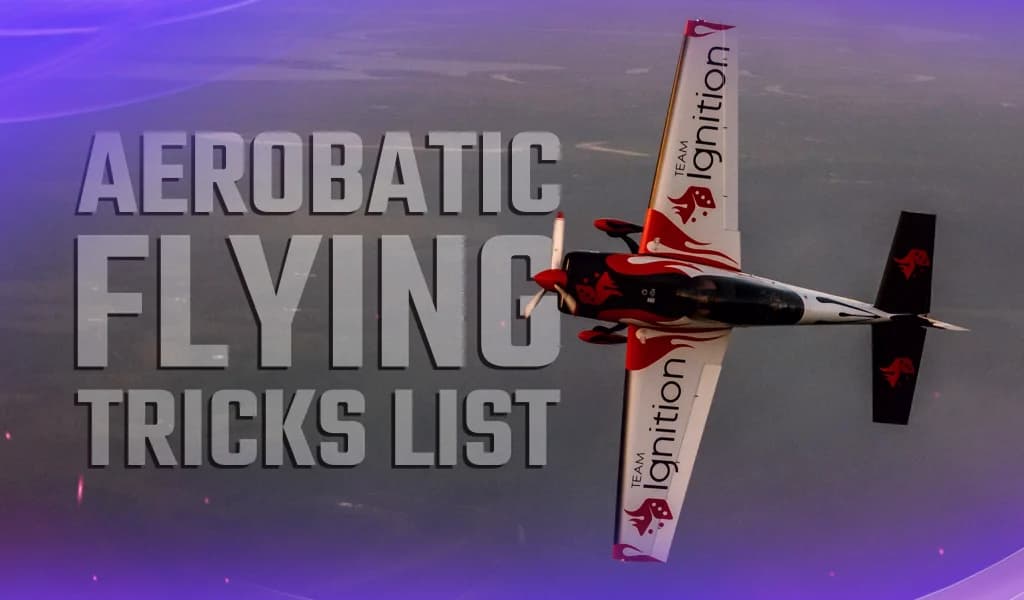
- Loop – the airplane points the nose up and circles around in the air until it is pointing the same direction it started (like a loop on a rollercoaster).
- Aileron roll – the airplane rotates like a chicken on a rotisserie.
- Barrel roll – the airplane rolls while gently looping, moving in a corkscrew pattern.
- Hammerhead (stall turn) – the airplane climbs straight up, almost stops, then points the nose downward to continue flight in that direction.
- Snap roll – a very fast, sharp roll caused by stalling part of the wing.
- Vertical eight – two vertical loops flown back to back, in opposite directions.
- Avalanche – a loop with a quick snap roll at the top.
- Humpty bump – a straight climb up, a flip over the top, then a straight drop back down.
- Tailslide – going straight up until the plane stops and then slides backward.
- Lomcevak – a wild, tumbling motion.
- Cobra – a dramatic pitch-up where the nose snaps high while the airplane stalls.
- High-alpha pass – flying slowly with the nose very high.
Famous Aerobatic Pilots
One of the very first aerobatic celebrities was Bob Hoover, often referred to as “the pilot’s pilot.” Hoover flew Spitfires in the United States Army Air Forces during World War II. His plane was shot down in 1944, and he was forced to spend over a year in a German POW camp. He boldly escaped and flew to safety in a stolen enemy plane. Many remember him for his exciting aerobatic displays in the many decades he flew in air shows after the war, delighting crowds all the way until his retirement in 1999. He was best known for doing routines with the engine shut down.
Sean D. Tucker was a champion aerobatic pilot from the U.S. He won numerous air show championship competitions throughout his career, was named one of the 25 “Living Legends of Flight” by the Smithsonian’s National Air and Space Museum in 2003. He was also inducted into the National Aviation Hall of Fame in 2008. He had a flair for the dramatic, and truly helped popularize modern aerobatics.
Kirby Chambliss is a multiple-time aerobatics champion and world-class competitor known for aggressive, technically demanding routines. As a boy in Corpus Christi, Texas, he always wanted to be a pilot. He saw his father’s skydiving feats and would watch the plane trailing behind with avid fascination. He ultimately became a night freight pilot and also flew private jets. Later in his career, he enrolled in aerobatic flight training and took on the competition circuit, where he excelled. Now, he’s known all over the world as one of Team Red Bull’s most daring pilots.
Emma McDonald is notably the only female aerobatic pilot in Australia, a rare distinction that speaks not only to her trailblazing status but to years of disciplined training, formidable technical skill, and the impressive backstory that led her there.
Aerobatic Flying Safety
While many of the maneuvers look wild and crazy, the parameters for performing aerobatic tricks are quite well defined. There are specific requirements for entry speed, altitude, exit positioning, and more. It is a very strict sport. Deviating from those parameters is treated as an error, not a matter of pilot style. Adherence to these standards is the first line of defense when it comes to safe flying.
Training is also quite rigorous. It involves experiencing intentional “mistakes” so that pilots can learn to correct them and ensure that any issues arising during flight won’t lead to disaster.
The aircraft used in aerobatics are different from standard passenger planes. They can handle higher structural loads, are more responsive to inputs, and are designed to fly well upside-down and under heavy G-forces.
Lastly, pilots are quite disciplined. They don’t just “send it” like another extreme athlete might. Pilots know to abort if conditions are wrong. Naturally, this can also be true for other alternative athletes, but the consequences of a failed BMX trick are generally quite a bit different than a plane crashing out of the sky.
How Are Aerobatic Flying Competitions Judged?
In formal aerobatic competitions, pilots must perform predetermined sequences composed of specific figures. They are judged along defined criteria like geometry, smoothness, symmetry, and precision. For example, loops must be round, centered, and done at a consistent velocity. Rolls must start and stop precisely. There can be no hesitation or drifting if a pilot wants top marks.
Errors lead to penalties. Small deviations result in fractional deductions, while major mistakes mean a zero for the figure. Judges are trained to focus on objectivity to keep scoring consistent across events.
Competitions are divided into categories based on experience level. This gives newer pilots a chance to get on the competition ladder. At higher levels, sequences become more complex and physically demanding. Last year’s winner at the 2025 U.S. National Aerobatic Advanced Championship was a pilot named Marty Flournoy, who took the top spot even though the plane’s control stick slid off the end of the shaft mid-flight.
How Does One Become an Aerobatic Flyer?
Many aerobatic pilots come from commercial, agricultural, or military flying backgrounds. But a private pilot can still start the journey by obtaining a basic private pilot license. Then, it would be necessary to start formal aerobatic instruction with a qualified instructor. It’s also essential to have access to an aircraft engineered for aerobatics.
The Future of Aerobatic Flying
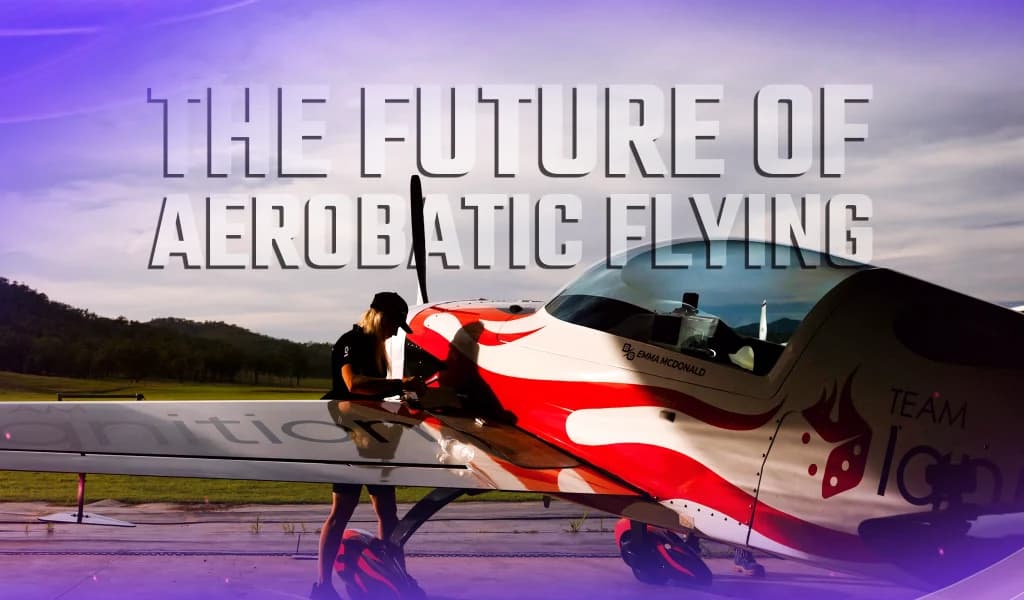
The sport of aerobatic flying continues to attract dedicated pilots drawn to mastery and precision. Aircraft technology is evolving, offering lighter, stronger materials and better aerodynamics. Modern planes are easier to fly, although it will likely remain quite challenging to pull off the toughest maneuvers in high-level competition. Training methods are also getting better thanks to simulation tools and standardized instructional curricula. And the sport is still getting safer, with a lot of emphasis on preparation and restraint.
For many years to come, the skies will still be home to feats of incredible daring and control, thanks to the world-class athletes drawn to the inspiring world of aerobatic flying.