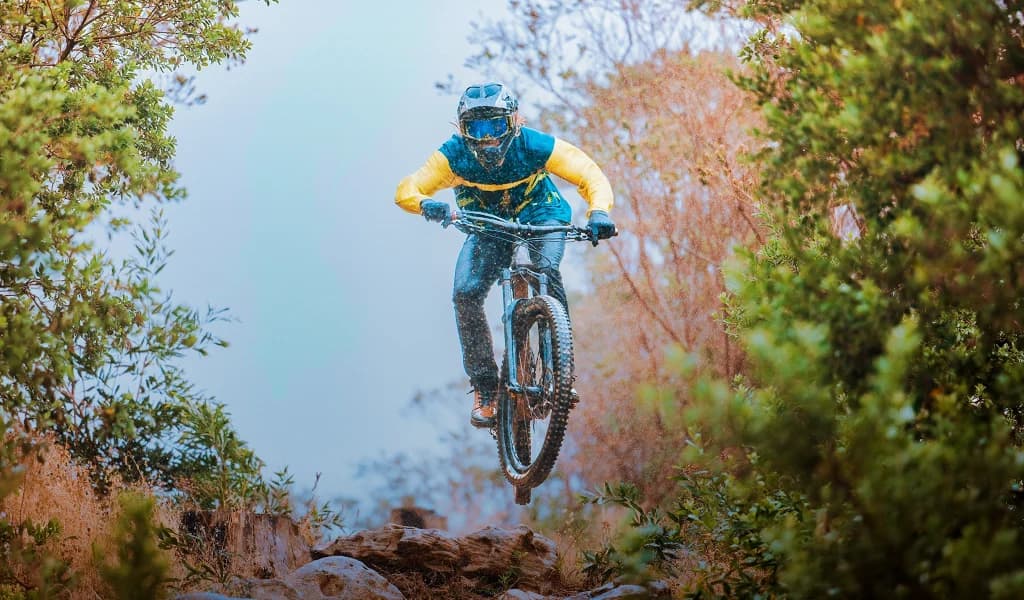
Out in sunny San Diego, at Strait Acres, Selema Masekela caught up with pro mountain biker Kyle Strait – and started taking his first jumps on a bike on the way.
Kyle took Selema under his wing and helped him build up his skills so he could start catching air. Under Kyle’s expert guidance, it wasn’t long before Selema was ready to hit the track himself – but keeping up with the Red Bull Rampage champion was another thing entirely.
In their sit-down, Kyle broke down the mindset needed to hit the biggest drops, the multiple disciplines freeride mountain bikers need to master, and what it was like coming back from what could’ve been a career-ending injury.
No Rules, No Limits
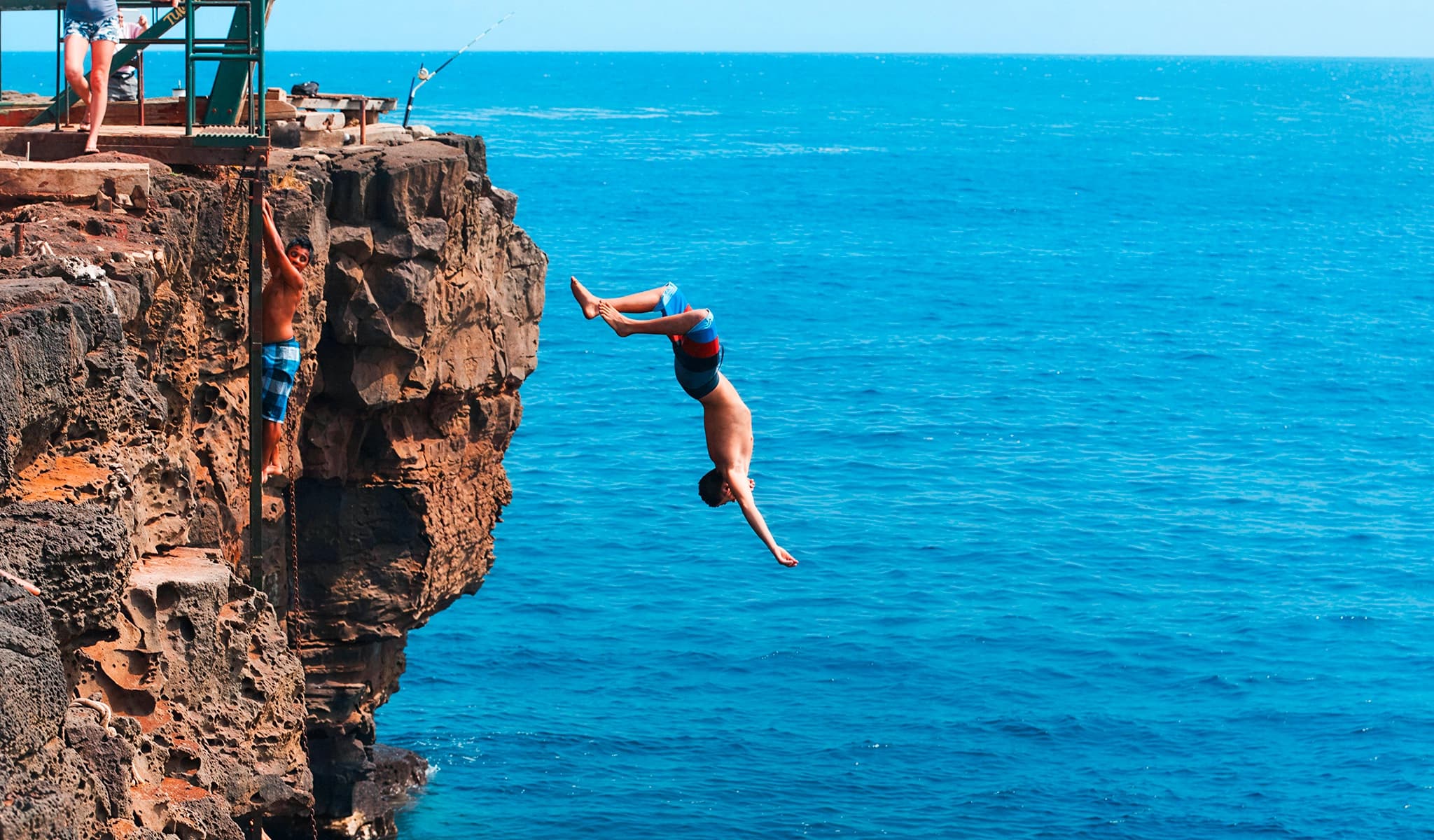
There’s nothing normal about riding your bike right off a cliff.
If it seems extreme on skis, then it’s downright insane on a bicycle, and yet freeride mountain bikers do it all the time.
Freeride mountain biking takes riders from the red rock canyons of Utah to the moss-draped mountains of British Columbia and out over the wild granite faces of Tasmania.
It’s exciting, it’s free, and it tests the very limits of what is possible on two wheels.
But it’s a different beast than racing. Freeriders are judged on creativity, line choice, and the sheer amplitude of what they’re willing to throw down the mountain.
But where did it all begin?
Origins and Evolution
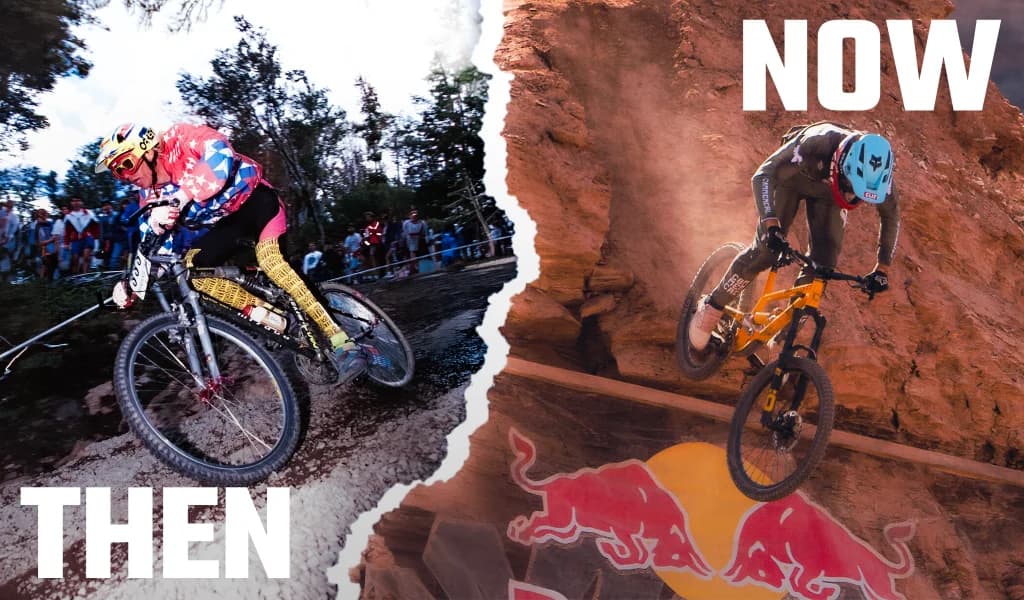
Freeride mountain biking was a bit of a reaction against what biking had become in the early 1990s.
There were lots of individual niche events like cross-country, downhill, and dual slalom. These had their own highly specific rules, course definitions, and time pressures. A chunk of serious riders found these events didn’t scratch the itch they had for two-wheeled action, so they began taking on the mountains themselves. It was raw, free, and creative.
Riders on the North Shore of Vancouver kicked things off.
Whistler, already a premier resort for alternative sports of all kinds, became host to elevated wooden features like ladder bridges, skinnies (a narrow wooden plank – typically just a few inches wide, suspended off the ground), and gap jumps. They wove into trails that shot through old-growth timber forests.
Freeriding took a totally different skill set from what bikers were used to before. Videos like Kranked and New World Disorder put the new sport on display, and soon after, a movement was born.
It wasn’t long before Red Bull joined the fun with an event called Rampage held in Virgin, Utah, in 2001. The sandstone landscape offered insane features, and freeride went from niche experiment to “extreme” sport. Over two decades later, Rampage is still running strong. It now even features a women’s event.
Three Key Skills: Control, Terrain Reading, and Creativity
Elite freeriders rely on three key skills when participating in events:
Bike Control
Bike control is the most obvious one. This includes body positioning at speed, which changes depending on the feature. Steep descents require riders to keep their hips low and back. In contrast, going over a jump requires the body to be centered with arms and legs acting as a suspension as the rider tackles unpredictable terrain.
Braking techniques change for freeriders as well. Grabbing too much front brake on loose surfaces will send the front wheel washing out. Too much rear brake will make the bike skip wide of an intended line. Elite riders use just the right amount of pressure, feathering brakes at times to maintain traction while keeping momentum. As in any high-level sport, riders get the best results when their vehicles feel like extensions of their bodies.
Terrain Reading
Terrain reading is more complex than it looks. This issometimes what elevates a good rider to a great one. Before a rider decides to send it over a major feature, they have to analyze it. They need an understanding of the ground, and so will simply walk the line they intend to ride. Riders check rocks with their shoes, get a feel for soil consistency, and might even take note of how shadows will fall at the time of day they’ll be riding.
It’s critical to visualize the trajectory of a drop, calculating where tires will land relative to the slope angle. A feature that looks quite scary from below may ride smoothly if the entry speed is on point.
Meanwhile, a feature that looks straightforward from above might have a hidden compression at the bottom that will send a rider right over their handlebars. Veteran riders learn how to put all this together for a successful ride, and they pay the consequences when they don’t get it right.
Creativity
Creativity is what takes freeride mountain biking from a sport to an art form. Downhill riders want the fastest line, while freeriders are trying to find the coolest one.
This is where things really get fun. They might launch off a rock face ito snag a line to a narrow dirt ramp into a jump. They could also shoot for a line that has them threading a canyon gap that no one has ever cleared. At the most interesting times, they will do something that no one saw coming.

What Separates the Elite from the Rest
This makes it clear that elite riders can’t be boring or overly safe. Basic riders will follow established lines, but top performers will do something special. At Rampage, riders and their dig crews spend days reshaping terrain to build kickers, sculpt landings, and carve some channels through sandstone.
The line a rider chooses after that really reflects their entire riding philosophy. Thus, a bold, creative line that is executed perfectly will outscore a technically safer line every time.
Flow is another separator. “Survival riding,” where the biker holds on for dear life and barely makes it down in one piece, doesn’t look very graceful. Flow is the opposite. The rider adapts in the moment, moving with the mountain rather than against it.
Flow comes from locked-in speed management, from hitting transitions in the right way, and from simple terrain familiarity.
The mental game doesn’t get a lot of discussion, but it’s often the most decisive factor in some runs. Committing to a feature at high speed requires the brain to override primitive self-preservation instincts. It’s something that freeriders share with big wave surfers, wing suiters, F1 racers, and many other adventure sport pros.
The rider must have a clear, committed mental state — there can’t be a flicker of doubt at the point of no return.
Doubt will almost certainly lead to a crash. Managing that internal environment and finding ways to be calm and focused in spooky situations is a skill that separates the elite from the rest. It sets apart riders who can train on difficult features from riders who can actually perform on them under pressure when the lights are bright.
Freeride Bike Tech
Freeride bikes are built to take serious abuse. They offer around 170–180mm of suspension travel in both the front and rear of the bike. The shape of the bike is also built for stability at speed, which means long wheelbases and low bottom brackets that keep the rider’s center of gravity planted.
Frames are made from aluminum or carbon fiber that can absorb very heavy impact loads (riders landing 60-foot drops will generate forces that would easily destroy a normal retail bicycle).
Components need to handle the same conditions. Brakes have to scrub speed on near-vertical faces without overheating. Tires need thick casings and aggressive tread patterns for grip on a variety of loose, unpredictable surfaces. Wheels are built around wide, strong rims paired with tough hubs that can handle shocking impact. All of these help riders stay in control when navigating intense terrain.

Red Bull Rampage and the Events Pushing Limits
No event has done more to define and elevate freeride mountain biking than Red Bull Rampage. The event gathers the world’s best freeriders and gives them a huge hillside, a dig crew, and a few days to build and rehearse their lines before a judged finals run.
Scoring rewards a combination of difficulty, execution, flow, and creativity. This has pushed the progression of tricks and lines to surprising new heights. Backflips off natural features that were considered impossible a decade ago are now routine.
Double backflips, cork 720s, and massive gaps cleared with casual style are all normal now, and the difficulty baseline at Rampage shifts dramatically with each passing year.
Iconic moments from Rampage have become part of mountain biking legend.
There’s Jordi Lunn’s enormous drops, the late great Kelly McGarry’s monster canyon gap backflip, and of course Kyle Strait’s relentless aggression across multiple victories. These are huge benchmarks that every subsequent generation of riders measures themself against.
Freeride mountain biking is a sport, an art form, and a physical science. At its highest levels, it produces moments of astounding human achievement. But the soul of freeride will always be there in every rider who ever stopped at the top of a scary obstacle, took a breath, and then took the plunge to find glorious excitement down below.