
When Selema Masekela traveled to Texas to meet Jorden Halvorsen, a four-time world champion bull rider, he learned just how much grit this sport truly requires.
After putting Selema through a series of drills designed to build the balance, grip, and mental toughness bull riding demands, Jorden threw him straight into the deep end, getting him up on a real bull for the very first time.
In their sit-down, Jorden broke down what it actually takes to stay on top of a 2,000 pound animal for 8 seconds, the childhood decision to ditch figure skating and horses for bulls, the jaw-dropping injury list she has collected along the way, and her near-death moment when a single misstep left her on an operating table with surgeons fighting to save her life.
Eight Seconds of Chaos
Bull riding looks like a sport that must have started on a dare.
It pits a person against a two-thousand-pound animal, and the person “wins” if they can ride and hang on for a mere eight seconds. Eight seconds feels like an eternity atop a bucking bull.
The sport isn’t entirely reckless, though. If you spend time around the arena, you’ll find that it is a precise discipline. It’s a skill that takes timing, balance, strength, and a special level of composure that not everyone can reach. Those who master it are acknowledged as elite athletes. They have learned how to sit on a hurricane and stay there no matter what.
The Mechanics of Riding a Bull
Surprisingly, riding a bull isn’t just about brute strength. Having a strong arm and grip is big, but position is every bit as important. Riders first mount the bull in a chute, which is a little penned area where a rider gets on a bull before it is released to run wild in the arena. There, the rider has time to get their grip squared away.
The bull rope is a flat braided rope that is tied around the bull’s body. The rider wraps it around their riding hand and then settles in using a technique called “getting a handle.” They pull the rope across their palm and then lock in a sturdy grip. The goal is not to hold on for dear life, though. If the grip is too tight, the rider may struggle to release when the ride is over, and this can lead to a disaster. The grip is really about connection, not control.
From there, it’s all about posture. The riding hand stays on the rope, with the elbow slightly bent. Riders keep their chin dropped to their chests. If their head flaps backward, it will put too much weight backward. This is an error that often leads to a failed ride. Riders have to be careful not to lean too far forward, either, or the bull’s drop will smash the rider’s face into the bull’s neck.

Heels are pressed down and forward, with knees acting like the shock absorbers of a car. The rider’s other arm swings free (but must not touch the bull – any contact with the free hand results in disqualification). In general, the rider is trying to stay centered over the bull’s hump, a position referred to as being “in the pocket.”
All of this has to happen correctly, and there’s very little time to think. A rider has to feel everything and will rely on thousands of hours of training. For this reason, elite bull riders spend lots of time on mechanical bulls, barrels, and practice stock. Good riding technique has to become ingrained so that when the lights are bright in the arena, the rider is ready to go.
Reading the Energy of a Bull
Professional bull riders have to be students of animal behavior. Before they go for a ride, they need to watch a tape of their opponent, just like a football team does. Their assigned bull likely has tendencies that should be analyzed. Some bulls might break out of the chute and cut left. Or they might drop their shoulder early on a spin. Speaking of which, some bulls are big spinners, rotating fast this way and that in an effort to dislodge the rider. Others are powerful buckers, flaring their back legs out into the air again and again.
Some are both, and will try all kinds of tactics to keep a rider from having a single moment of stable comfort.
Against spinners, riders lock into rotation and will try to anticipate the bull’s drop cadence. It’s a bit like timing a jump rope. When dealing with a bucker, it’s all about absorbing force. Riders try to stay somewhat loose in the hips and back so that impacts will flow through their bodies. The goal is to sync up with the bull, not to fight it. It is a wild dance, and few can handle it with any grace. In fact, this ability is what often separates the young talent from the seasoned vets. Young riders may rely on athleticism to muscle through some seconds of a ride, but a master will read the animal and maximize correct use of technique to get a longer ride done.
A Note on Scoring
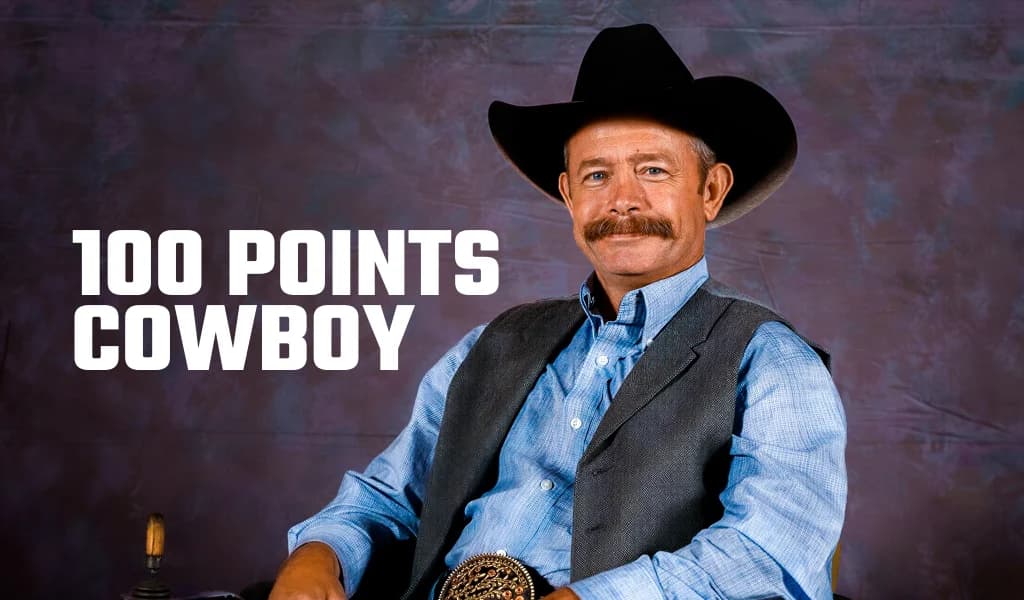
Professional bull riders are scored with 100 points being the maximum possible. Half are based on athlete performance, and half on the bull. That is, a bull that gives a very hard ride will lead to a higher score for the rider than one that can make it the full eight seconds (no points if dislodged before then). Similarly, a rider who appears to be composed and in control will get a nice score, while a rider who is rag dolled, but who somehow stays mounted, will get a lower score. A score in the high nineties is considered fairly legendary, and a perfect 100 is essentially never awarded (one awarded to Wade Leslie for a ride atop “Wolfman Skoal” in 1991, a record that has never been matched).
It All Goes Back to Texas
The epicenter of bull riding has always been Texas. The two are so deeply intertwined that you can hardly think of the Lone Star State without always imagining a cowboy, at the very least. The Professional Bull Riders (PBR) tour and the Professional Rodeo Cowboys Association (PRCA) both rely on Texas to steadily produce new bull riding talent.
Why?
First, Texas has the infrastructure. There are lots of small-town rodeos going on all the time, throughout the state. From Pecos to Nacogdoches, weekends in summer for many people mean a trip to the arena to see competitions. And the starting ages for bull riders probably will shock those not familiar with the culture down south. By the time a young rider hits the high school circuit (managed by the Texas High School Rodeo Association), they may already have years of competitive experience under their belt buckle. There’s just no substitute for regular experience like that.
The culture also reinforces it. In ranching communities, physical toughness is just an expectation. Texas famously promotes a strong work ethic, self-reliance, and the ability to get back up. Young riders know pain, and they know how to manage it in ways that folks from other areas may not.
Managing Fear — Psychology in the Chute
Fear rides alongside competitors in bull riding. They have to work with it — raw adrenaline is going to be there. Good riders convert it into focus and get on with the fun.
In the chute, before the nod that opens the gate and starts the ride, bull riders say that their attention narrows. The sounds can dull and the world shrinks down to the bull, the rope, and the rider. They also spend a lot of time visualizing the ride beforehand, so they can keep their mind on a successful ride and not worry about what can go wrong. They have this in common with fighter pilots, surgeons, and anyone who has to work under pressure with high-stakes consequences.
Because failure will come, eventually. There’s no question of that.
The Physical Toll of Bull Riding
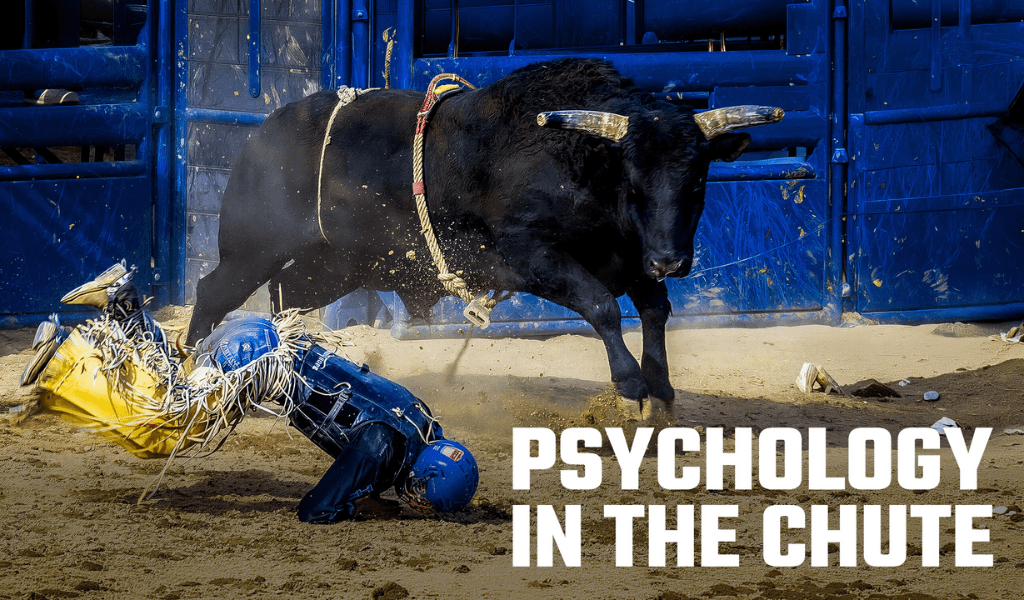
Bull riding can be like a car accident that takes eight seconds to unfold. The forces on the rider are very nasty. Even a good, successful ride can lead to injury. A bad ride can lead to life-altering harm. Cervical strain, shoulder separations, broken ribs, torn ligaments in the hand and wrist… these are the occupational realities a bull rider faces. And when you add in the possibility of being thrown upside-down and trampled, it becomes quite obvious why modern bull riders have more protective gear than in years past.
Today’s riding vests use high-density foam and sometimes even feature air-bag systems that deploy on impact. Helmets were often criticized by the tough guys of yesterday, but are now a common fixture in the pro circuit. High-profile head injuries have a way of changing the conversation.
In fact, the sport’s relationship with sports science is still evolving. Strength and conditioning programs made for bull riders are becoming more common. These focus on hip mobility, core stability, and reactive strength that help riders absorb impact. The old model, which had riders go until broken, rest, then ride again, is giving way to something more sustainable.
The risk is always there, no matter what. And for many riders, that’s the whole reason to climb on the bull in the first place.