
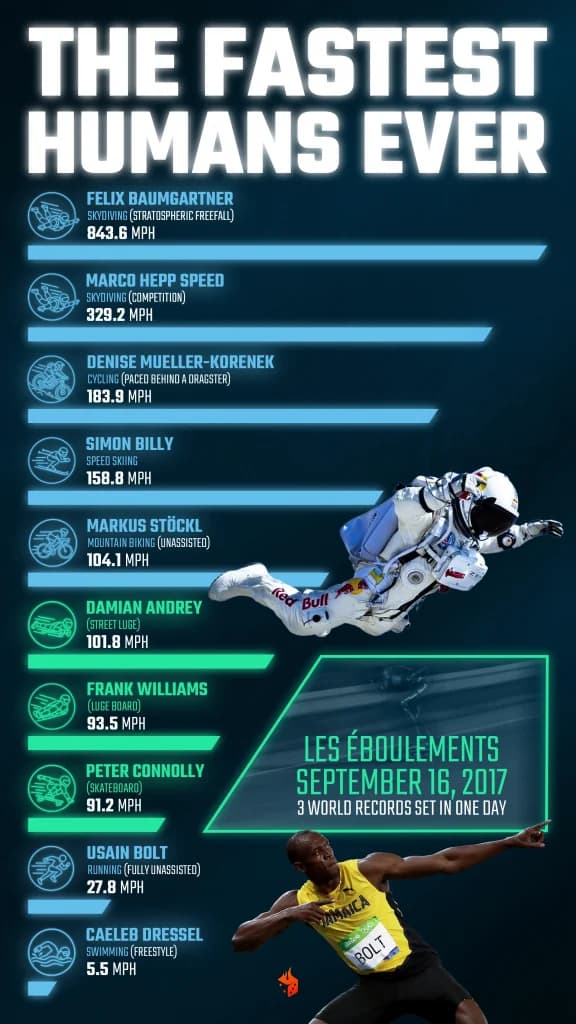
Speed records get attention. Usain Bolt’s 2009 world record for the 100-meter dash wasn’t just the best time for that event, it was also the fastest a human being has ever run on foot. Bolt hit a top speed of 27.78 mph, and it’s the high bar for sprinters everywhere.
But that’s the fastest a human has ever gone on foot. If you take cars, planes, and other motorized vehicles out of the equation, human beings have hit some intense top speeds on their own.
We’re always looking to find ways to hit those top speeds and break those speed records. Let’s dig into the fastest speeds people have gone without an engine of any kind.
In the Air: Falling Is the Fastest Way Down
The human body in freefall moves incredibly fast, and so skydivers have reached crazy speeds using nothing but the pull of the Earth.
In a standard jump, terminal velocity (the point where drag and gravity cancel each other out) lands somewhere around 150-180 mph, according to the World Air Sports Federation. Competitive “speed skydivers” are a different breed. They mimic the peregrine falcon and dart downward like arrows shot headfirst. Using this technique, German skydiver Marco Hepp set a competition record of 329.2 mph. He did it with nothing but a specialized aerodynamic suit on.
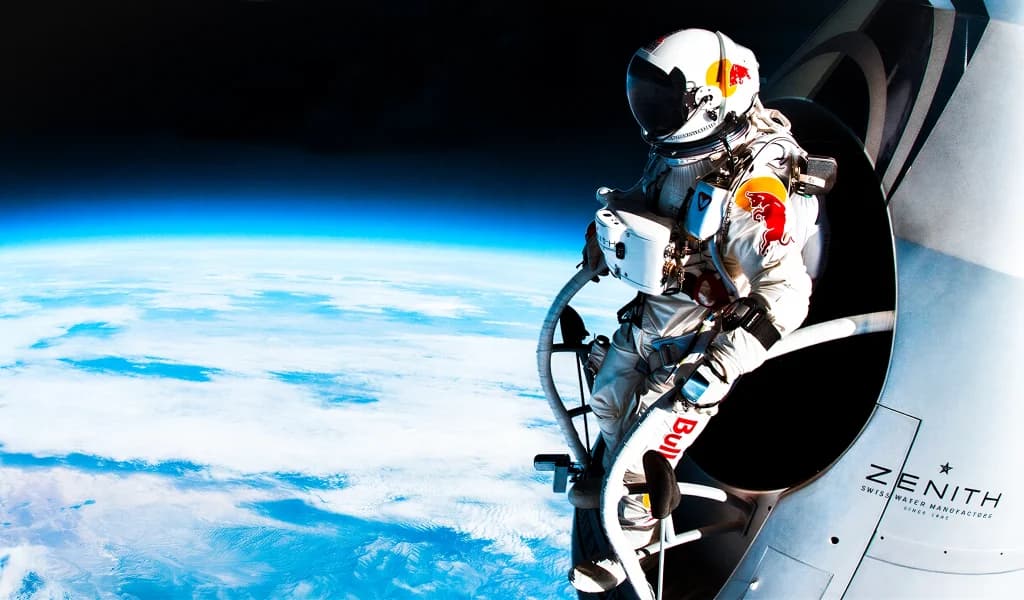
Skydiving speed junkies will also always remember Felix Baumgartner, who famously stepped off a Red Bull Stratos capsule that was 24 miles above New Mexico. As he fell back toward Earth, he hit a staggering peak speed of 843.6 mph. It made him the first human to break the sound barrier using only his own body.
Professional high divers, jumping from only 70 feet or more, report that some jumps feel like a car crash. One can imagine what Baumgartner was risking when he became a human meteor that day.
On Snow: The Fastest Human on Land
Falling is probably the most extreme speed category, but skiing demands a kind of technical precision skydivers never have to deal with. Speed skiing involves a straight-line sprint down a steep, groomed mountain track using nothing but skis, an aerodynamic suit, and full commitment to being on the knife-edge of control (and probably a frightening margin beyond it, if we’re being honest).
In March 2023, French skier Simon Billy set the current men’s world record, hitting 158.8 mph while bombing a run at Vars, France. Billy described it as close to total sensory deprivation. Speed skiers have their visor down and can hear nothing but the wind roaring by them as they go more than double the speed of a car on the highway.
Speed skiing is essentially the fastest a human being can go across the ground, under their own control, without any mechanical assistance. Once again, it’s gravity doing the work to get them going.
The Olympics don’t have an event for this sport, though. It showed up once in a demo for the 1992 Albertville games, but a training accident saw it scrapped shortly after. The record chase continues, though, centred around the annual Speed Masters event in Vars. Every major record in the sport has been set there since 2014.
On Wheels: Cycling Like Mad
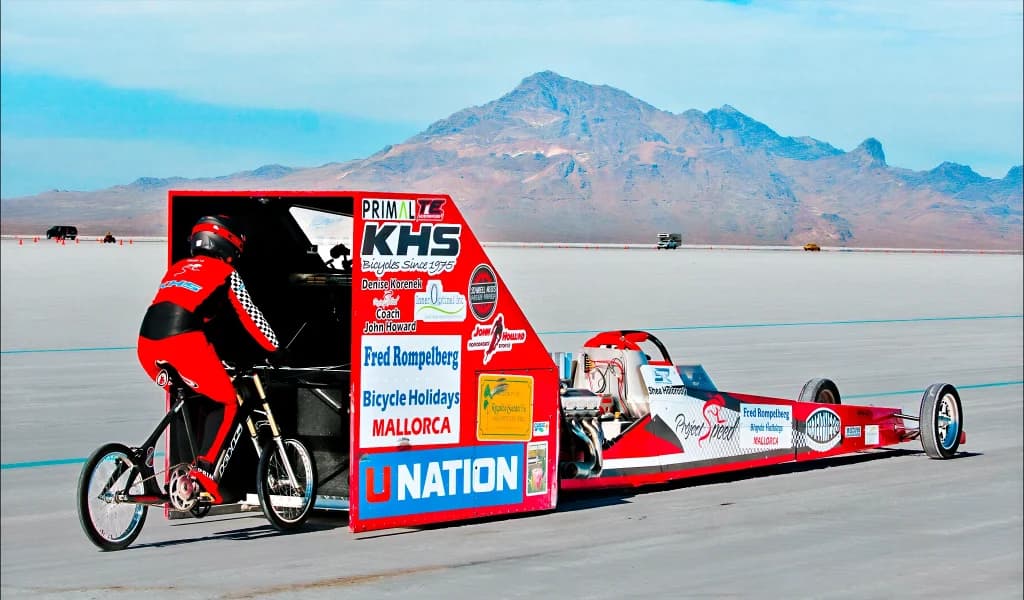
Do bikes belong on this list? Admittedly, there’s an engineering assist, but the only real motor is the human rider, so it counts. The fastest a person has ever gone on a bike is 183.9 mph. Denise Mueller-Korenek set the record in 2018 on a custom bike.
That bike’s gearing was extensive. A custom-built dragster towed Mueller-Korenek up to her starting speed on a salt flat and acted as a barrier to cut drag on the bike. All the power from there came from Mueller-Korenek’s legs.
Still not enough pure speed? Look no further than Austrian mountain biker Markus “Mad Max” Stöckl, who hit 104.1 mph on a standard mountain bike while bombing a run down a slope in Chile’s Atacama Desert. You can watch his first-person perspective if you want to experience the white-knuckle run for yourself.
On the Ground: The Gravity Sports Family
There are a few more sports that aim to make use of gravity, reduce friction, and hit bone-rattling speeds. These include downhill skateboarding and luge. The basic technique is similar in each: lie down or crouch as low as possible, minimize wind resistance, and let a steep run do the rest.
Les Éboulements in Quebec, Canada, in September 2017 was the magic time and place. There, Peter Connolly reached 91.2 mph standing on a skateboard, Damian Andrey hit 101.8 mph on a street luge sled, and Frank Williams reached 93.5 mph on a classic luge board.
Three world records, three disciplines, one hill, over the same weekend. (For those wondering, Olympic-track ice luge speeds also top out right around Williams’s mark).
On Foot: The Limits of Human Muscle
There’s a purity to running that makes it a natural draw for would-be record breakers. Usain Bolt’s top recorded speed of 27.8 mph, set in 2009 at the World Athletics Championships in Berlin, is still the record.
There’s not much of an assist from gravity, engineering, or special clothing, so this is a unique record. Given Bolt’s singular talent, breaking this record will be a challenge for most competitors. Given enough time, though, any record’s bound to be broken.
In the Water: The Slowest Fast Humans
Swimming is different from the other speed sports in this article. The athletes are still elite, but water is not very hospitable to humans who try to go fast, and the speeds are not very impressive in comparison. The resistance factor is huge (water is 800x denser than air), and we are not built anything like sailfish, who can reach 60+ mph in the water.
Caeleb Dressel holds the current 50m freestyle world record, averaging roughly 5.5 mph at peak speed. In the mildly assisted category (for the curious), Michael Phelps was able to hit 8.8 mph while using a monofin.

The Need For Speed
The pattern with human speed records is obvious: we’re always looking for a boost, and our top speeds make use of whatever we can get to reach new heights.
When we’re working without mechanical assistance, our top speeds are powered by physics: steep slopes, thin air, small wind profiles, and even a vehicle’s draft to hide behind.
Athletes supply the rest: the technique, the training, and the nerve to stay in control when vibrations are communicating that we’re on the edge of what can be controlled.
Speed skiers spend years learning to hold an aerodynamic tuck without compromising form once they hit top speed. Downhill skateboarders and luge racers have to obsess over suit design and body position the way Formula 1 teams obsess over their car’s aerodynamics. Baumgartner’s insane record required a human being to stay conscious, controlled, and functional while breaking the sound barrier with nothing but a suit between him and the stratosphere.
The effort really is the quest to see how far the human body can be pushed. The answer is always the same: further than anyone expected.