
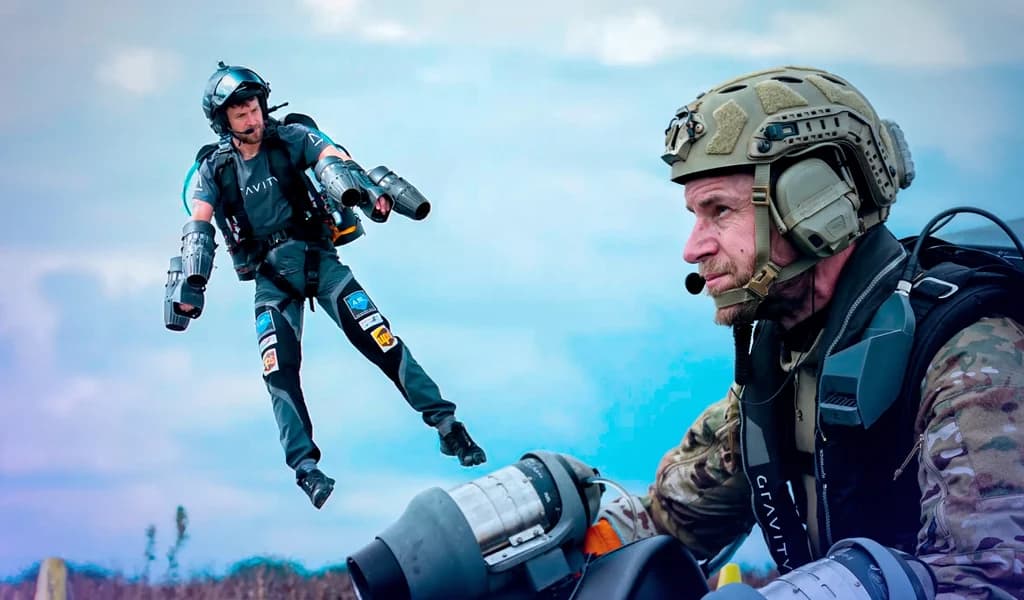
You hear him before you see him.
Jet engines tend to make a lot of noise, even when they’re miniature versions of the kind used on commercial aircraft. And out in the countryside of Somerset, England, they’re not the type of noise you normally hear – that is, before Richard Browning began working on the futuristic dream of a jet suit that would allow people to fly like Iron Man.
(Missiles and lasers are not yet part of the standard kit. For now, Richard’s jet suit simply flies.)
But what made him want to take to the air?
Early Life
Aviation was in Richard’s blood. His grandfather was the Chief Executive Officer of Westland Helicopters, and his father, Michael, was an aeronautical engineer and inventor. Richard spent plenty of time in his childhood building and flying model gliders with his father. Tragically, his father died when Richard was 15, and he sought the stability of a traditional career path.
In 2001, he earned his BSc in Exploration Geology from Cardiff University. He then joined British Petroleum and spent the next decade and a half as a commodities trader in London. His instinct to invent never left, and he earned the BP Group Innovation Award for developing a tracking platform for global cargo ships. The platform was built on a shoestring budget and generated around $50M in profit for the firm in just a few months.
Richard also simultaneously served six years as a reservist in the Royal Marines, earning his “green beret” (in Britain, this is a commando-type designation available to those in multiple branches of the military – it’s different than the American specialists of the same name). Richard is also an avid ultramarathoner. He brings a mindset of perseverance and belief in the wondrous capabilities of the human mind and body, all of which would come in handy as he worked toward a tremendous breakthrough in flight.

First Jet Suit Experiments
One idea that Richard couldn’t let go of was the thought that, if a person had propulsion sources mounted on their body in the correct configuration, they could figure out how to fly in a balanced way.
The first experiment was with a mini gas turbine engine – a scaled-down version of the engines used on airplanes. One turbine provided about 50 pounds of thrust, and so two of them were enough to provide some lift to a grown man as he jumped and tried to stay upright. As Richard powered up the designs, he put two turbines on each forearm and one on each leg. The problem was resisting the impulse to walk in the air, which severely disrupted balance while flying. He eventually got rid of the leg thrusters for this reason. During the iteration process, he also realized the forearm mounts would create a desirable “hanging” effect, and that back-mounted turbines could complete the “tripod of thrust” needed to make flight intuitive and sustainable for longer periods of time.
In 2016, he flew. Properly. He was able to move forward, stay upright, and have it be reasonably intuitive to maneuver. This eventually led to controlled landings on desired platforms. What had started as “what if” gradually became “what’s next?” He continued developing configurations and materials and eventually created the world’s first practical jet-powered flight suit.
How to Fly and Current Jet Suit Capabilities
Richard had conquered the initial challenge of making his flight suit wearable and controllable without wings. But notice that no one said it would be “affordable.” His jet suit costs around half a million dollars.
There are no control sticks. Instead, desirable movement comes from arm positioning and subtle changes in posture. Triggers in the hand grip provide the amount of thrust needed. It’s more like learning how to ride a hoverboard than how to pilot a flying machine. The pilot isn’t isolated from flight. Instead, the person wearing the suit really has to feel how things work.
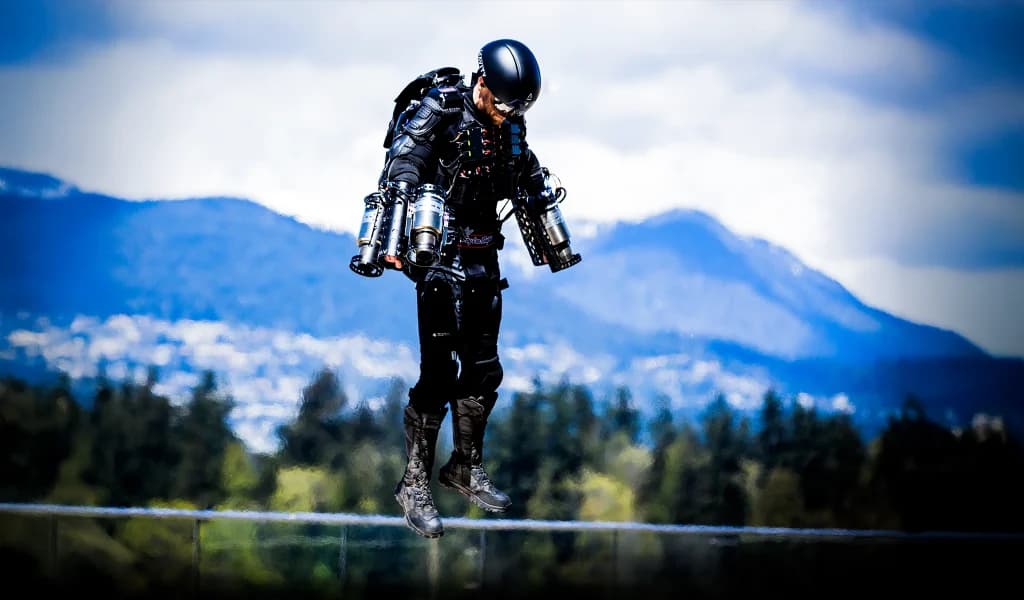
Over time and iterative designs, performance has steadily improved. Richard’s jet suit can fly faster than 50 miles an hour, with record attempts going all the way to a blistering 85. The suit could reach high altitudes, but the issue really becomes gas. Flight times last a few minutes, relying on jet fuel. Electric options are currently constrained by battery tech, which isn’t sufficient for sustained vertical thrust.
The suit itself is also quite heavy, around 50 lbs. dry and nearly 100 if fully fueled. Advances can make it lighter, however. Jet suit designers also must constantly keep safety in mind. Human flight is inherently dangerous, and is made more so when you can point a jet engine at your body. Pilots keep engines pointed away and wear flame-retardant clothing. If one were to point the jets directly at their body, it would not instantly cause a fire. Richard likens the engines to hair dryers, where it would take sustained close contact to cause damage.
Building Gravity Industries
As the suit became a commercial reality, Richard founded Gravity Industries to formalize the effort to share his jet propulsion suit with the world.
Apart from the continued engineering effort, there are multiple ways to promote jet suit technology. One is simply through exciting public demonstrations that raise awareness. Richard flies over cityscapes, coastlines, and landmarks to show people what his invention is capable of. He’s aware of the “real-life Iron Man” perception that surrounds him online. He doesn’t really focus on leaning into that image, but generally prefers to help people understand that the suit isn’t a costume. Instead, it’s a serious step forward in human aviation.
He’s also keenly focused on the usage of the jet suits for the military, as well as for first responders and rescuers. Gravity’s suit enables them to quickly fly to inaccessible areas in minutes that would take far longer to hike to.
For thrill seekers, Gravity offers one-off flight experiences for a few thousand, and allows adventurers to sign up for a more intensive flight training program for people who are more serious about developing their jet suit skills.
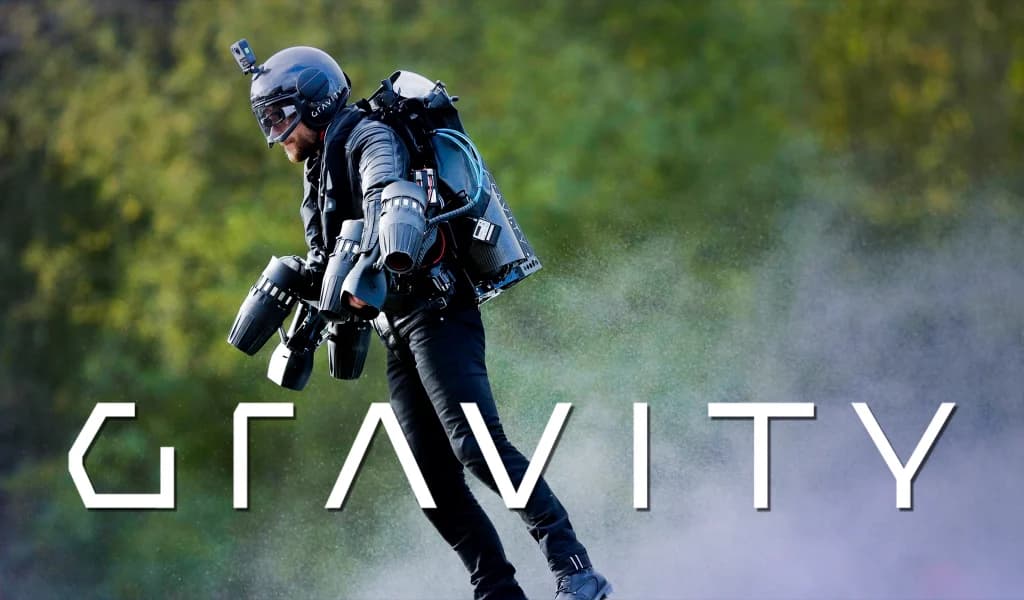
Building the Future in the Lab in Somerset
Richard’s Somerset “lab” facility is no sterile futuristic tech setting like you’d see on a movie set. Instead, it’s a place where work gets done. It’s part workshop, part flight range, and a place where ideas come to life for immediate testing. There, his team can take engines apart, adjust components between flights, and really get into the rhythm of development. Build, test, analyze results, and then loop around to the beginning again.
It’s also a place to train. Flying a jet suit isn’t easy right off the bat. It takes practice. Pilots also need to be in decent shape because it requires strength, core stability, balance, and coordination. They fly using a very loud system that has quite a bit of power and they need to stay in control of it. It’s not unlike racing a thoroughbred in that way. A jet suit pilot must respect the power that’s in their hands, and then it can take them to some amazing places.
Real World Jet Suit Uses
The military has been quite willing to put the suit to use. The Royal Marines have worked through test flights to see if rapid boarding of ships in the water might be more effective with Richard’s technology. Helicopters and ladders are at a disadvantage when it comes to immediate maneuverability and quick landings. Jet suits allow soldiers and sailors to quickly get onto a hostile craft.
Search and rescue operations also offer opportunities to put jet suits to use. Mountainous terrain is famously hard to handle on foot. Any rescue efforts take up quite a lot of time if teams have to hike in. Helicopters are incredibly expensive to run and can’t always safely land where needed. Jet suits open up the possibility of getting someone on site in minutes. In one Lake District test, rescuers got to a spot in 90 seconds that would have taken a team on foot about 25 minutes to reach. This could easily be the difference between saving a life and not.
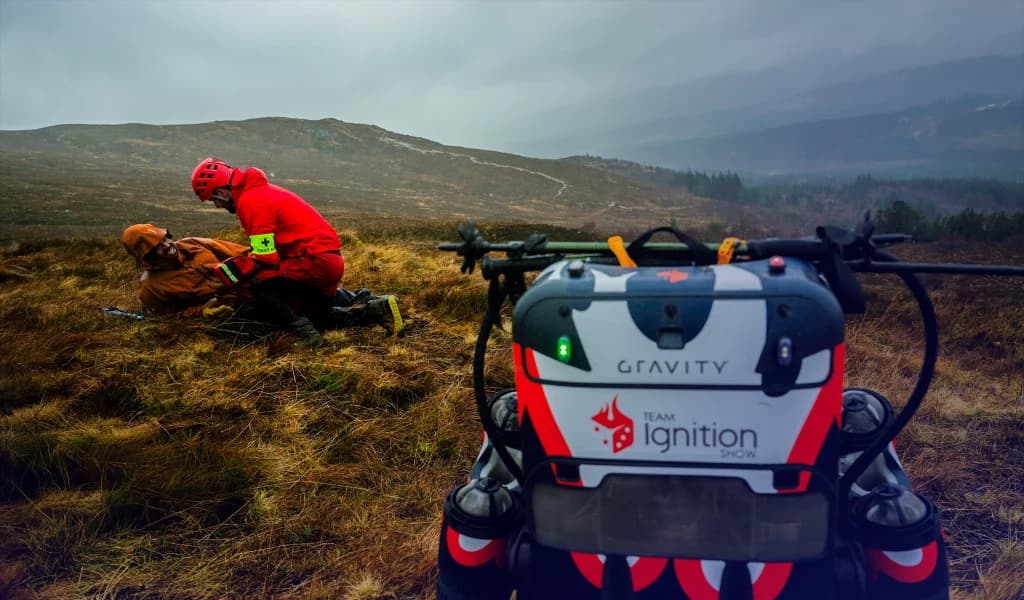
The suit, of course, has limitations. You can’t carry much with it. It is very loud (it has this in common with helicopters). Flights must be short. And the weather can make flying a jet suit too difficult. But all transport methods have their advantages and drawbacks, so adding this to the tool kit will undoubtedly help some team somewhere in the world do things that they could not do before.
One day, a paramedic could fly in on mini jets and help someone in need. It’s a highly specialized situation that will call for this type of action, but it could easily be a difference maker in the future.
What’s Next for Personal Flight?
In addition to finding practical uses for the jet suits, there’s sport to think of. Inevitably, for anything that moves, there will be a bunch of people who want to go as fast as possible. Thus, it seems that jet suit racing will be inevitable as at least a super-niche sport. The first races have already taken place.
In the long term, Richard will also be seeking to improve his suits. There’s plenty of room for optimization when it comes to fuel consumption, increasing flight duration, and experimenting further with aerodynamic elements (e.g., wings). Electric propulsion is also on the list of possibilities. Advances in battery tech could possibly make electric jet suits something that is feasible in the future.
And perhaps there will be assistive mobility uses for this tech? The offer is on the table for people to find ways to put jet suits to use, however they can.
Join Richard Browning on the Team Ignition Show
Bottom line: there are people who accept the limits of physics. Richard Browning is not one of them. In this episode of The Team Ignition Show, Selema Masekela gets rare access to Gravity Industries – the lab where Richard has spent over a decade building, crashing, and perfecting the world’s first human jet suit.