
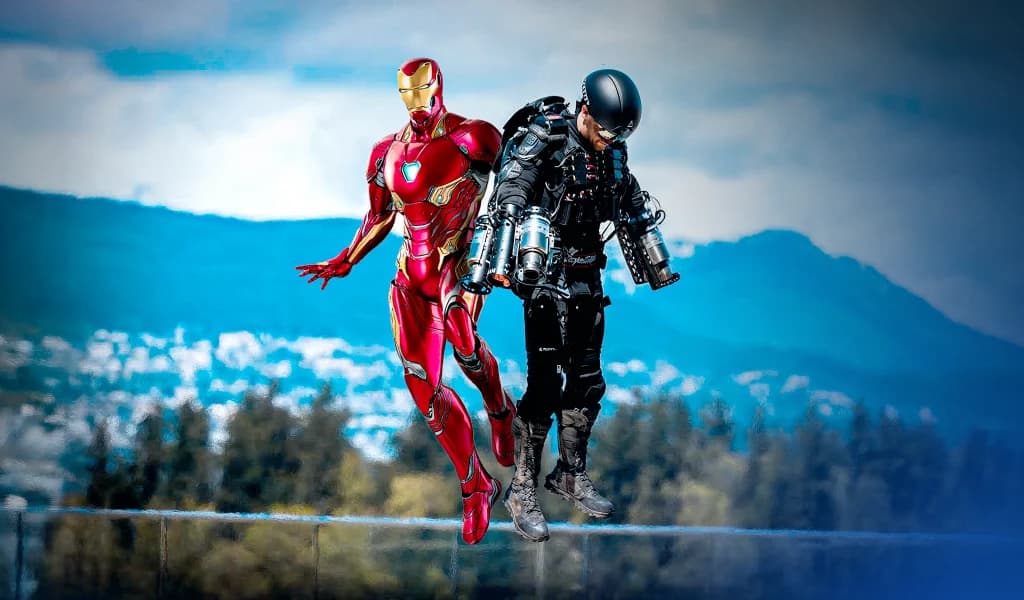
When Selema Masekela stepped into Gravity Industries, he got a firsthand look at how Richard Browning spent over a decade building and refining the world’s first human jet suit—walking through early prototypes, crashes, and the breakthroughs that made it real. Richard shared what it felt like to first fly, the business moves that kept it alive, and how a parking lot demo led to a $650,000 deal. By the end, Selema took the controls himself before heading into the mountains, where the jet suit was pushed to its ultimate test in a live rescue simulation.
Chasing Human Flight
The engines ignite with a high-pitched whine. The pilot lifts off the ground. No cockpit, no seat, no controls. Just seven miniature turbines, two arms, and a body learning in real time what it means to fly. The dream is older than it looks.
The first “rocket belt” was invented in the late 1950s by Wendell Moore of Bell Aerosystems. It was a beautiful marvel of engineering, but it had a major constraint: it only offered about 20 seconds of flight, and it burned through its fuel load almost instantly. It famously featured “polished fuel tanks and control arms, custom-machined valves and foil-wrapped exhaust nozzles, stainless hoses and fiberglass backboard.” This prompted one historian to say that it looked like a “hot-rod scuba rig.”
It had little practical use.
Later jetpack designs were great for stunt showcases and demonstrations, but didn’t really address the core problems that left a gap between dreams and real-life applications of jetpack technology. Users wanted longer flight times, better control, and a safer overall design.
It wasn’t until a flight-loving oil trader and British Royal Marines reservist named Richard took hold of the problem that marked a significant breakthrough.
Building the Impossible

Flight was never far from Richard’s life. His grandfather ran Westland Helicopters. His father, Michael, was an aeronautical engineer who spent weekends building model gliders with his son on the grass. Richard absorbed it all: the mechanics, the obsession, the belief that humans could always push a little closer to the sky. He just took a detour first. A geology degree. A career in oil trading. Years in London, moving commodities while the old dream sat quietly in the background, waiting.
All the while, those aeronautical designs and dreams were still rolling around in his head. And more than that, he had an interest in intuitive flight – something almost like human augmentation. His theory was that, with the right tech, a person could teach themselves how to fly by feel, much like how we get a feel for surfing, riding a bike, or gliding along on a hoverboard.
It took years of experimentation to prove it, but the instinct was correct from the start.
A number of technological advancements paved the way for Richard’s jet suits. As with so many innovations, he had to stand on the shoulders of giants and peer just a little higher than the rest had before. Gas turbine engines (like those used on airplanes) became smaller and more efficient. Sturdy materials got lighter. Engineers gained a better understanding of thrust control. These small improvements stacked over time and created the opportunity for Richard to begin his experiments.
The first flights were awkward, but showed that the concept had promise. He strapped turbine engines onto the arms of a pilot. These were then pointed downward to generate lift. It was enough for extended jumping, but an engine on each arm wasn’t enough to take to the skies. He tried multiple turbines on the arms and legs, but the issue with this design was that he kept instinctively trying to walk, which destabilized every flight. The winning design was creating a “tripod of thrust” with two turbines on each forearm and three worn on the back (as in the Mark IV suit in use in 2026). Pilots could take off, land, and maneuver around without too much trouble.
By 2016, his company, Gravity Industries, had created the first working jet suit design that was going to be truly practical for widespread adoption. And an 80 mph jet suit has a way of getting people’s attention.
Seven Engines and a Leap of Faith
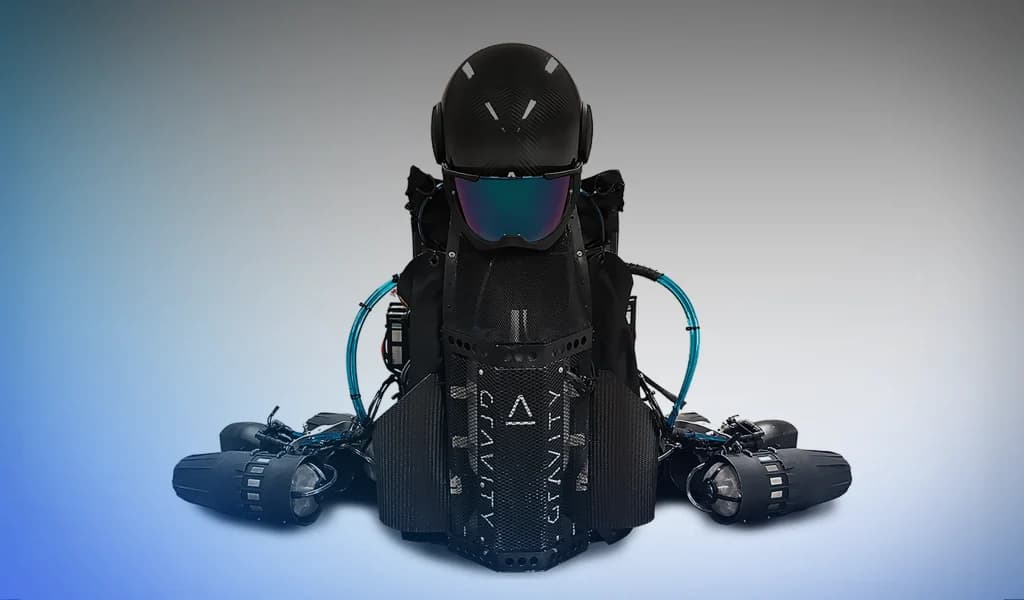
Richard’s current design runs on seven miniature gas turbines, two on each forearm and three on the back, burning standard aviation kerosene. When all engines are firing, the combined thrust exceeds the pilot’s body weight and flight begins. There is no joystick or cockpit. Pilots lean forward to accelerate and adjust their arms to turn, the same way a surfer shifts weight on a wave. Flights last around eight minutes, and most pilots stay below 30 feet and well under the suit’s 80 mph top speed, both to conserve fuel and keep the margin for error as wide as possible.
Unlike piloting an aircraft, flying a jet suit is closer to learning to snowboard. The body and brain are the flight computer. It takes strength, coordination, and time to build the instinct for it.
Where Jet Suits are Already Working
Jet suiting is still in the early stages when it comes to real-world adoption, but there are a few organizations that are testing the possibility of incorporating the technology into their procedures.
Search and rescue
Mountain rescues are notoriously difficult. Helicopters may struggle to find a place to land, or even to fly successfully over certain geography. But when hiking to the scene of an incident would take a long time, a nimble jet suit pilot could reach someone in need much quicker. In one test, rescuers going on foot would have taken possibly 30 minutes to arrive on scene, but a jet suit pilot did it in about 90 seconds. That kind of response time could save lives. Unfortunately, a jet suiter cannot carry an injured person, which would be a huge game-changer if it became possible.
Military
Similarly, the military is finding that jet suits can move personnel quickly when doing things the traditional way would be time-consuming. One such use is going from ship to ship in the water. Pilots can rapidly insert themselves into difficult environments, avoiding some of the issues posed by helicopters or hiking to the destination. The technology is now used, but is still undergoing testing.
Sport and entertainment
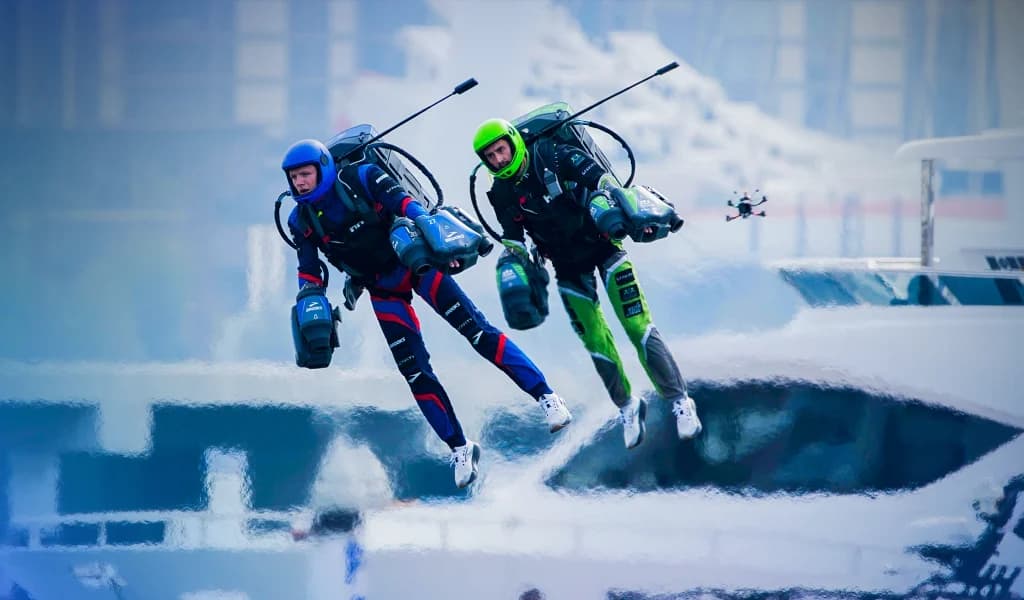
Jet suit racing [JB2] is already an exciting niche sport and may be what brings the technology to a wider audience. It is also possible to simply go see a live demonstration or even book a flight experience package. Some of the more engaged pilots can even enroll in a training course to become skilled at flying jet suits. For now, owning one is only possible for the über-rich – units cost around half a million dollars.
Risk at 30 Feet
Yes, jet suit flying is risky. There’s a reason that the 2024 jet suit races in Dubai took place over the water. The altitudes are typically low to avoid severe falls, but pilots can get going at high speeds and need to fly carefully to prevent crashing. They wear helmets and flame-resistant clothing to decrease some of the risks, but the activity is inherently dangerous. There’s not much time to recover if things go wrong.
The fire risk is a reasonable concern. Richard likens the jet engines to a hair dryer, saying that prolonged contact at very close range is needed to cause a burn. If a small mistake could set a pilot on fire, the technology probably would have failed at the experimentation stage, or would require a much more significant protective suit for pilots to wear.
Highly trained pilots only use jet suits for low, controlled flying. The margin for error is narrow, and experienced pilots know it.
What Comes Next
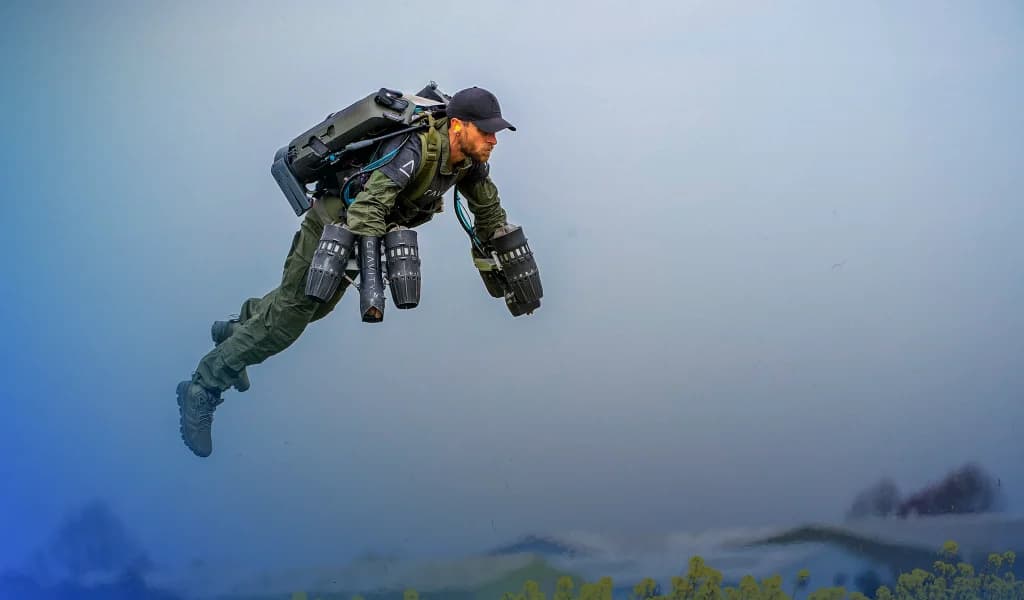
Flight time remains the biggest constraint. Eight minutes is a ceiling that fuel efficiency improvements could push significantly higher, and that single development would open up entirely new use cases.
Ease of use is less of a barrier than it sounds. Pilots with a background in surfing, snowboarding, or similar balance-based activities adapt faster than expected. The larger practical limits are payload and cost. Current suits can lift the pilot and little else, which rules out cargo or passenger transport for now.
And at half a million dollars per unit, widespread adoption is still a long way off. If costs drop into luxury car territory, the equation changes considerably.
Jet suits aren’t ready for the masses yet. The flight times are short, the costs are steep, and the risks are real. But the gap between science fiction and the morning news has never been smaller.